Cube Confidence Club — private 1-on-1 cubing coaching for children
Skill first. Speed second. Mastery throughout.
From First Solve to Real Speedcubing.
Private 1-on-1 online cubing coaching built around your child’s current ability, personal goals, and measurable progress.
From first solve to F2L, PLL, faster times, and competition preparation, the training path starts with the student.
- 12 Weeks
- Private 1-on-1
- Ages 8+
- Online
- Application Only
Founder solve
See the Skill in Action
A real solve by Sam. No cuts. No tricks.
Fast solving gets attention. Good coaching builds the student.
Different Students, Different Goals
Every Child Starts Somewhere Different.
One child may be holding a cube for the first time. Another may already solve in 90 seconds and want to reach 45. Another may be learning F2L, full PLL, or preparing for a first competition.
We start with 3 simple questions
- 1What can your child do now?
- 2What do they want to achieve next?
- 3What is the clearest path to get there?
Once we see how your child learns and performs, we set a realistic goal and build the training around it.
Your Child’s Starting Point
Where Is Your Child Right Now?
Every child starts somewhere different — and that is exactly where we begin.
Some are solving their very first cube. Others are already fast and ready for the next breakthrough.
Tell Us What Your Child Wants to Achieve
There is no “right” starting point. We look at where your child is today, what excites them, and what progress would feel meaningful — then build the training path around them.
The Training Method
Diagnose → Learn → Practise → Correct → Integrate → Perform
Six repeating stages. Each one exists because skipping it is where progress usually stalls.
- 01
Diagnose
Find the true bottleneck.
We watch the student solve and note the current method, technical level, pauses, inefficient movement, algorithm knowledge, recognition problems, Cross planning, F2L issues, turning mechanics, response to mistakes and practice habits.
- 02
Learn
Teach the next high-value skill.
No overload of unnecessary algorithms. The coach asks one question: what single skill would produce the greatest next improvement for this student?
- 03
Practise
Repeat the skill in controlled conditions.
Isolated F2L pairs, Cross drills, Cross + first pair, slow solves, PLL recognition, algorithm repetition, transition drills, timed solves and execution drills.
- 04
Correct
Fix the habit while it is still forming.
The coach watches mistakes happen in real time. Correction happens before an inefficient habit becomes automatic.
- 05
Integrate
Put the skill back into full solves.
A student may understand F2L in isolation and still lose it during a complete solve. Integration closes that gap.
- 06
Perform
Repeatable performance, not one lucky solve.
Timed solves, Ao5, Ao12, video recordings, competition-style simulation and the agreed personal benchmark.
I don’t just teach the skill. I watch the skill being built.
Coaching vs Practice
Learning Is Not the Same as Practising
Teaching explains the technique. Practice reveals whether the technique survives repetition, mistakes, hesitation and the timer.
Coaching Session
Learn What to Do.
Purpose: Learn and diagnose
- Watch complete solves
- Identify bottlenecks
- Teach new technique
- Explain new concepts
- Introduce algorithms
- Improve F2L
- Analyse the Cross
- Improve recognition
- Assign drills
- Establish the next priority
Practice Session
Make It Work.
Purpose: Turn knowledge into reliable skill
- Supervised repetition
- Slow solves
- Isolated drills
- Recognition practice
- F2L repetition
- PLL recognition
- Timed solves
- Live corrections
- Error recovery
- Performance consistency
A student may understand F2L intellectually and still pause five seconds before every pair. A student may know a PLL algorithm and still take too long to recognise the case. A student may know the correct technique and abandon it when the timer starts.
Knowing is not fluency.
Learn → Practise → Get Corrected → Repeat → Perform
Who It Is For
A student who wants this.
Families who value highly personalised instruction and are willing to invest seriously in a child’s chosen interest. Primary student age: ages 8+.
- Already loves cubing
- Already solves and wants to progress
- Wants to start learning CFOP
- Wants to learn F2L
- Wants to learn OLL
- Wants to learn full PLL
- Wants to become faster
- Wants more structure
- Has plateaued
- Wants to compete
- Enjoys difficult skill mastery
- Is ready for regular practice
Who It Is Not For
When we would say no.
There is no judgement in this list. Private coaching is simply the wrong tool in these situations, and we would rather say so early.
- The child has no interest in cubing
- The activity is being pushed by the parent rather than chosen by the child
- The family wants guaranteed results without practice
- The family wants occasional drop-in tutoring
- The student is not willing to practise in a structured way
- The family is searching for the cheapest hourly tutor
Founder
Sam
Competitive cuber, coach, and lifelong student of the cube.
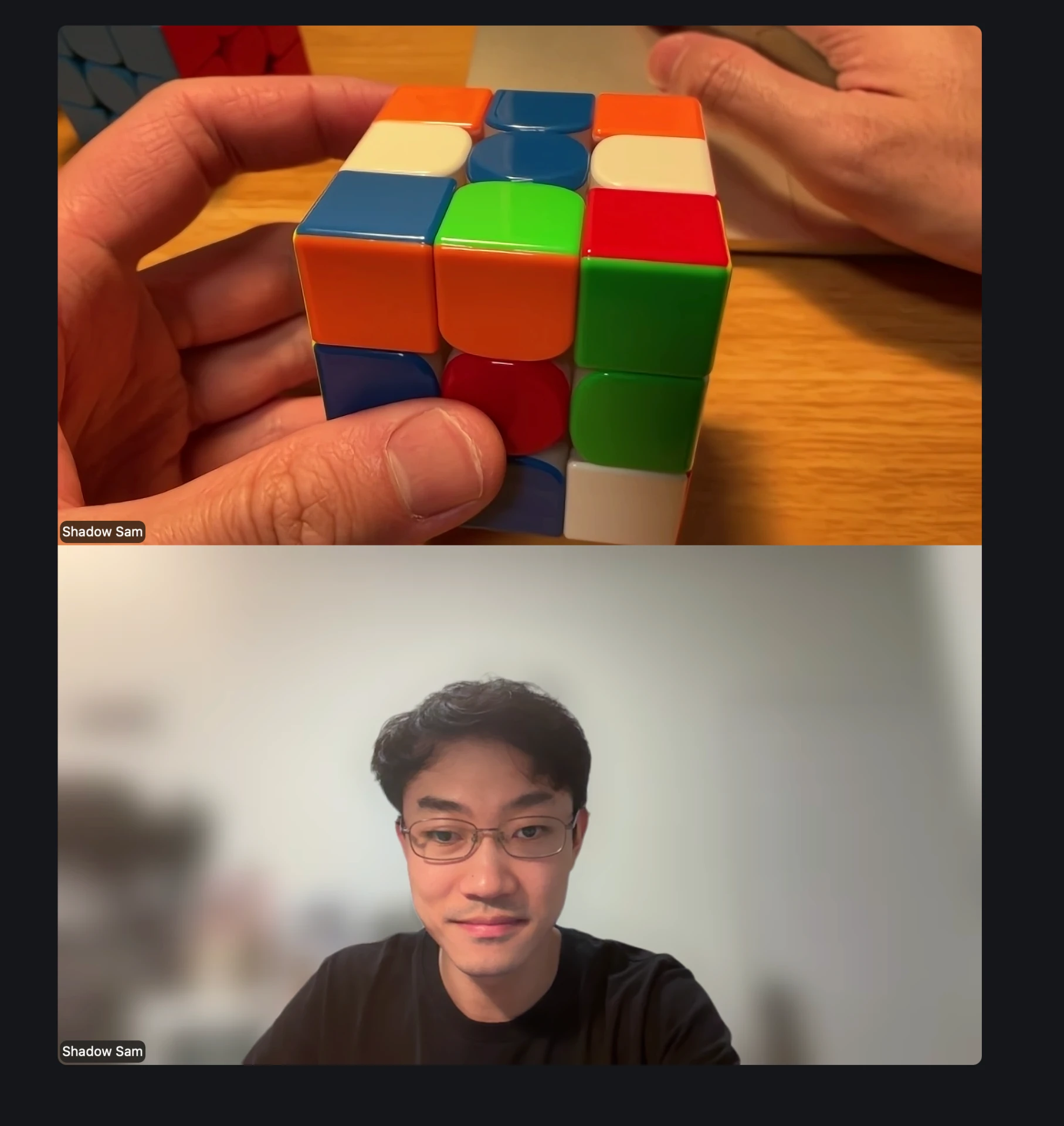
I started cubing in 2010 and entered my first competitions in 2012. Over the years, I competed at the 2015 Chinese National Championship, the 2016 and 2018 Asian Championships, and the 2019 World Championship, and I have also won two Pyraminx gold medals. Today, I enjoy using that experience to help young cubers learn more clearly, practise with purpose, and enjoy seeing themselves improve.
Private Coaching
A Personalized Program for Your Child.
Each student receives a training plan built around their current level, goals, and progress.
12 Weeks · Private 1-on-1 · Online
Program details and scheduling are discussed after the initial call.
How It Works
Start With a Conversation.
Every child is different. We first learn about your child, their current level, and what they want to achieve.
Book a Call
Tell us about your child, their current cubing level, and their goals.
Get a Free Trial Session
Your child tries a session and we see the best way to help them improve.
Build the Training Plan
If it is a good fit, we create a personalized plan for your child.
Private 1-on-1 · Online · Personalized Coaching
Questions
Straight answers, before any conversation about enrolment.
Skill first. Speed second. Mastery throughout.
The Goal Is Not Simply to Solve the Cube.
The goal is to become a cuber. Someone who understands what they are doing. Someone who knows how to practise. Someone who can identify mistakes. Someone who can learn increasingly advanced techniques. Someone who has a next goal.
Applications are reviewed individually before a private consultation is offered.